Press releases
Social entrepreneurship business models. Guide to the launch of social enterprises
Organisation for the Development of Small and Medium Enterprises (ODIMM) Moldova carried out Webinar and WorkshopU with theme “Social entrepreneurship business models. Mobile business model, which can be developed in social enterprises”.
The event analysed business models of social enterprises in Moldova and overseas. Several types of business models and ideas for social entrepreneurship activities were also offered as an example.
Common social enterprise models:
1. Cross-compensation — A customer group pays the service. The profits of this group are used to subsidise the service for another disadvantaged group.
2. Service fee — Beneficiaries pay directly for goods or services provided by the social enterprise.
3. Employment and skills training — The main aim is to offer wages, skills development and job training to beneficiaries: employees.
4. Market intermediary — The social enterprise acts as an intermediary or distributor to an enlarged market. The beneficiaries are the providers of products and/or services that are distributed in an international market.
5. Market connector — The social enterprise facilitates business relations between beneficiaries and new markets.
6. Independent support — The social enterprise delivers a product or service on an external market that is separate from the beneficiary and the social impact generated. The funds are used to support social programmes addressed to the beneficiary.
7. Cooperative — A profit-making or not-for-profit business, which is owned by its members who also use its services, offering virtually all types of goods or services.
At the same timethe model for the creation of a social enterprise, structured by the company’s co-fundator, has been exemplified; ‘EduJoc’ Igor Hincu.
In its view, the following guide is useful to create a social enterprise:
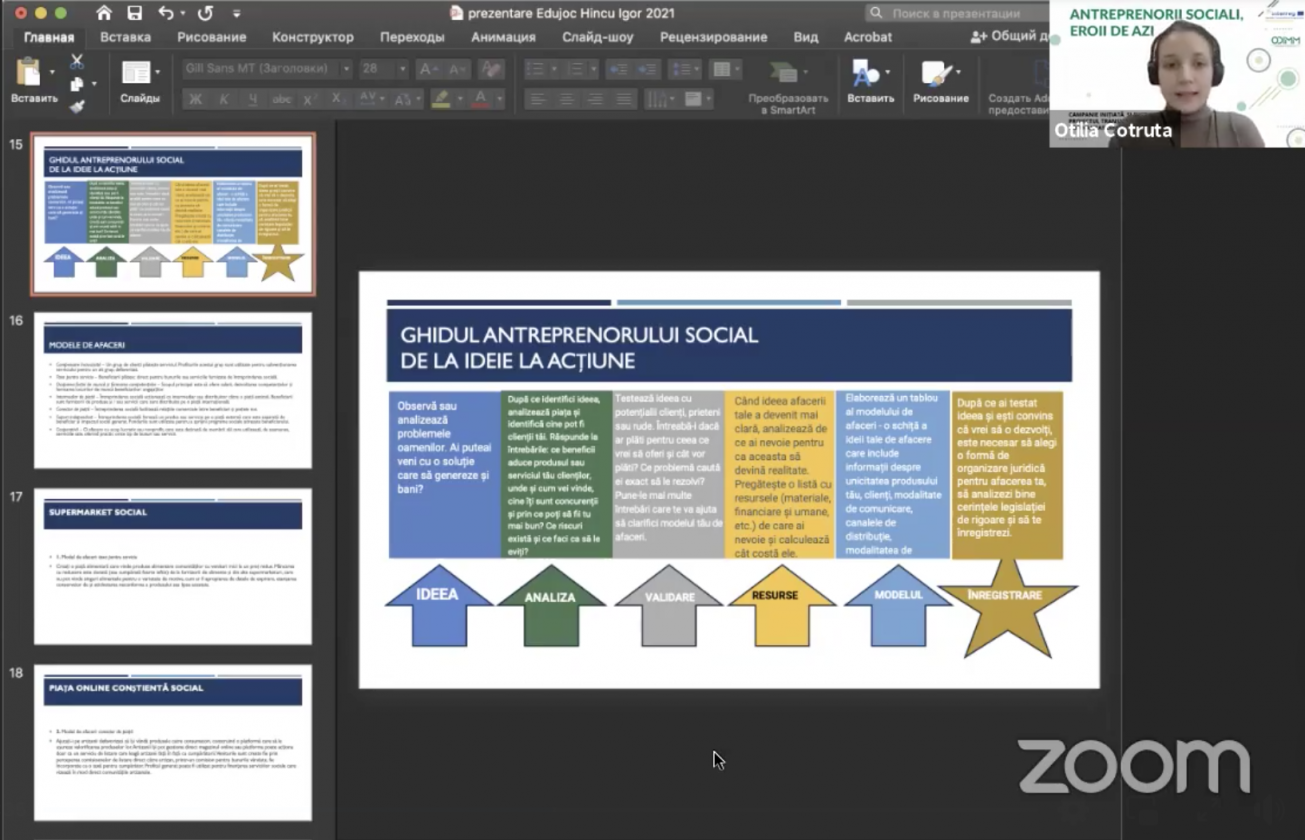
SOCIAL ENTREPRENEUR GUIDE: FROM IDEA TO ACTION
1. IDEA: Notes or analyses people’s problems. Could you come with a solution that also generates money?
2. ANALYSIS: Having identified the idea, analyses the market and identifies who can be your customers. Answers questions: what benefits will your product or service bring to your customers, where and how will you sell, who is your competitors, and how can you be better? What risks are there and what do you make them visible?
3. VALIDATION: Test the idea with potential customers, friends or relatives. Ask them whether they would pay for what you want to offer and how much will you pay? What problem do they look exactly to resolve? Ask them more questions that will help you clarify your business model.
4. RESOURCES: When the idea of your business has become clearer, looks at what you need to make it a reality. Prepare a list of the resources (material, financial and human, etc.) you need and calculate how much they cost.
5. MODEL: Develop a business model dashboard – an outline of your business idea that includes information about the uniqueness of your product, customers, communication mode, distribution channels, distribution mode.
6. REGISTRATION: Having tested the idea and you are convinced that you want to develop it, it is necessary to legislate a form of legal organisation for your business, to analyse well the requirements of the law of rigour and to register the requirements of the legislation.
The registration of the event can be accessed on this link: https://bit.ly/3wsqEGN
Series of training events dedicated to the promotion and development of Social Entrepreneurship continues. The agenda of the events can be consulted HERE.

Previously, the events have been carried out:
● Webinar + Workshop: “General views on social entrepreneurship. Benefits and opportunities” (Link registration: https://bit.ly/3pX1tuI)
● Webinar + Workshop: “Legal and practical aspects in obtaining social enterprise status” (Link registration: https://bit.ly/2ZGUBX9 )
● Webinar + Workshop: ‘Procedure for obtaining the job subsidy for disadvantaged persons’ (Link registration: https://bit.ly/3k48MNn)
● Webinar + Workshop: ‘Accounting issues and financial reporting in social enterprises’ (Link registration: https://bit.ly/3nXaktF)
● Webinar + Workshop: “Tax issues and social enterprise relief” (Link registration: https://bit.ly/3mNuret)
● Webinar + Workshop: “Particularities for the creation and management of social affairs” (Registration link: https://bit.ly/3qlmteH )
For prior registration to events of the Organisation for the Development of Small and Medium Enterprises, interested persons are invited to complete the form: https://forms.gle/s8xG2quRTw4zZFPC8
Registrants will receive the access link to the events held.
Campaign initiated and supported by the Transnational Finance4SocialChange project, co-financed by European Union funds (ERDF, IPA, ENI). The aim of the project is to promote social impacts and stimulate the development of companies interested in resolving Community problems. ODIMM is a partner, together with 19 other institutions from 15 countries in the Danube region.